






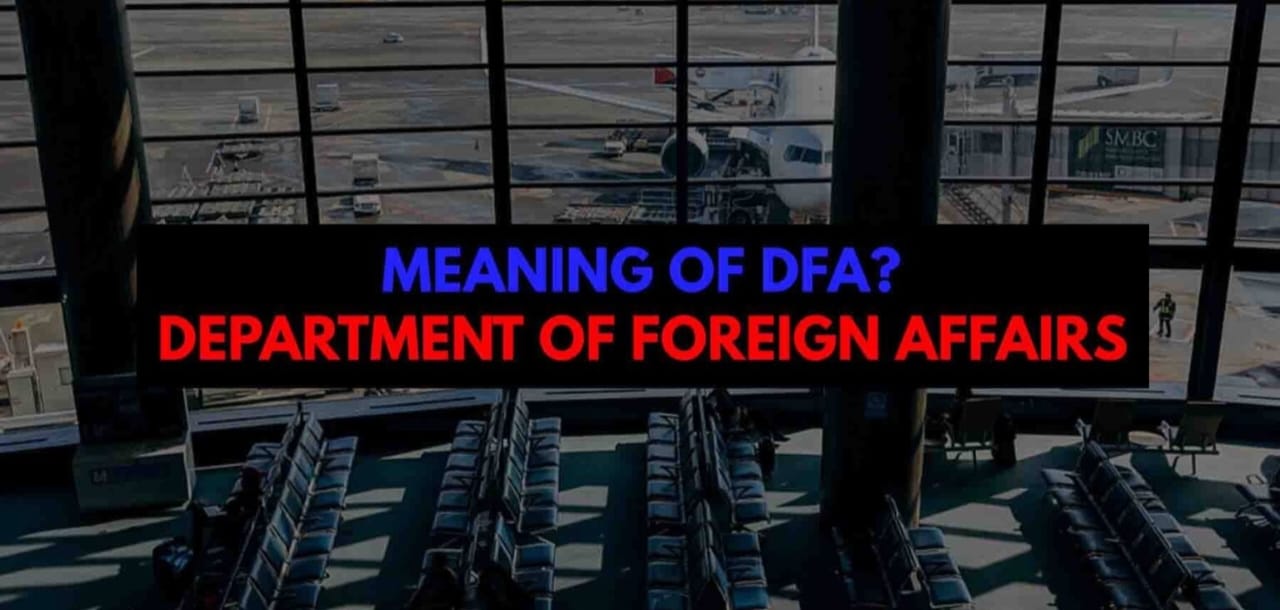
The Department of Foreign Affairs (DFA) is the executive department of the Philippines tasked with carrying out the foreign relations of the Republic of the Philippines.What is the Meaning of DFA – Department of Foreign Affairs Under the leadership of the Secretary of Foreign Affairs, the DFA is responsible for formulating, implementing, and coordinating the country’s overall foreign policy.
The primary goal of the DFA is to promote and protect the national interest of the Philippines. To achieve this objective, the department oversees various aspects of foreign affairs, including diplomatic missions, consular posts, and bilateral relations with other countries. It works in collaboration with other government agencies and international organizations to advance Philippine interests globally.
One of the crucial roles of the DFA is to ensure the welfare and safety of Filipino citizens abroad. It provides assistance and support to Filipinos living or traveling in other countries, particularly during emergencies or crises. The department also facilitates consular services such as passport issuance, visa applications, and document authentication to Filipino nationals.
Additionally, the DFA engages in diplomatic negotiations and representation on behalf of the Philippines in international forums and organizations. It participates in multilateral discussions, treaties, and agreements that affect the country’s interests. The department acts as a representative of the Philippines in promoting cooperation, addressing global challenges, and contributing to international peace and security.
In summary, the Department of Foreign Affairs plays a vital role in safeguarding Philippine national interests, protecting Filipino citizens abroad, managing diplomatic relations, and advancing the country’s foreign policy objectives.

The Department of Foreign Affairs (DFA) is composed of various bureaus and offices, each with its own defined role and responsibility. These bureaus and offices collaborate closely to accomplish the department’s overall objectives.
One of the key bureaus within the DFA is the Bureau of Consular Affairs. This bureau is primarily responsible for providing passport services, visa processing, and assisting citizens abroad. They handle the issuance and renewal of passports, facilitate visa applications for foreign nationals, and offer consular assistance to Filipinos in distress overseas.
Another significant bureau is the Bureau of Diplomatic Affairs. Its main focus is on managing and maintaining diplomatic relations with other countries. This involves coordinating with foreign embassies and consulates, organizing official visits and meetings between government officials, and representing the Philippines in international conferences and negotiations.
Additionally, the DFA includes offices such as the Office of American Affairs, Office of Asian and Pacific Affairs, Office of European Affairs, and Office of Middle East and African Affairs. These offices specialize in handling foreign relations and policy matters with specific regions of the world. They monitor political developments, promote economic cooperation, and address issues of mutual concern with their respective regions.
Moreover, the DFA also has offices dedicated to administrative functions. The Office of Consular Affairs manages the operations and services related to consular affairs, including the establishment and management of consular offices within the Philippines. The Office of Legal Affairs provides legal advice and support to the department, ensuring compliance with international laws and agreements. The Office of Protocol deals with matters of diplomatic etiquette, official ceremonies, and protocol for visiting dignitaries.
The collaboration and coordination among these bureaus and offices enable the DFA to effectively carry out its functions and achieve its objectives in the realm of foreign affairs.

Overview
The DFA, or Department of Foreign Affairs, is indeed widely recognized by Filipinos as the government agency responsible for handling passport and visa applications. However, its origins and functions extend beyond that.
The establishment of the DFA dates back to June 23, 1898, shortly after the Philippines gained independence from Spanish colonial rule. At that time, President Emilio Aguinaldo appointed Apolinario Mabini as the Republic’s first Secretary of Foreign Affairs. This marked the inception of the department, which played a vital role in forging diplomatic connections with other countries.
Over the years, the DFA has evolved into the primary agency responsible for implementing the Philippines’ foreign policy. Its main purpose is to advise and assist the President in planning, coordinating, and evaluating the nation’s overall foreign relations efforts. The DFA’s scope of work encompasses various areas such as diplomacy, international negotiations, treaty agreements, consular services, and the protection of Filipino citizens abroad.
While passport and visa services are essential functions provided by the DFA, it also engages in a wide range of activities to safeguard the country’s interests on the global stage. This includes representing the Philippines in international conferences and organizations, maintaining diplomatic relations with other countries, promoting cultural and economic exchanges, and handling diplomatic protocols and consular affairs.
In summary, the DFA is an integral government department that has undergone significant development since its establishment in 1898. From its early role in establishing diplomatic ties, it has grown to become the primary entity responsible for implementing the Philippines’ foreign policy and representing the nation’s interests worldwide.
The DFA is responsible for the following agencies:
- Foreign Service Institute Technical Cooperation Council of the Philippines
- UNESCO National Commission of the Philippines Secretariat
What is DFA
DFA is an acronym for the Department of Foreign Affairs.
Purpose of DFA
The Department of Foreign Affairs (DFA) is an essential institution that stands as a cornerstone of the Philippines’ Foreign Policy. It assumes a significant role in safeguarding and bolstering the national security of the country, working towards achieving economic security, and ensuring the protection of the rights and welfare of Filipino citizens living abroad.
As a pillar of the Philippines’ Foreign Policy, the DFA is entrusted with the task of maintaining and advancing the country’s national security interests. It actively engages with other nations and international organizations to forge alliances, establish diplomatic relations, and foster cooperation in areas such as defense, counterterrorism, and peacekeeping efforts. By actively participating in regional and global forums, the DFA promotes the Philippines’ security concerns, striving to create a stable and peaceful environment both domestically and internationally.
Furthermore, the DFA plays a crucial role in promoting and attaining economic security for the Philippines. It seeks to enhance trade relations, attract foreign investments, and facilitate economic cooperation with other countries. Through bilateral and multilateral negotiations, the department works towards creating a favorable environment for Philippine businesses to thrive, ensuring sustainable economic growth and prosperity for the nation.
An integral part of the DFA’s responsibilities is the protection of the rights and welfare of Filipinos residing overseas. The department provides consular services to Filipino citizens abroad, offering assistance in various areas such as passport and visa processing, legal aid, and crisis response. It also takes proactive measures to safeguard the rights of overseas Filipino workers, advocating for fair treatment, decent work conditions, and the prevention of exploitation or abuse.
In summary, the Department of Foreign Affairs serves as a vital institution that upholds and advances the Philippines’ national interests in various domains. Through its dedication to preserving national security, promoting economic stability, and safeguarding the well-being of Filipinos abroad, the DFA contributes significantly to the overall development and prosperity of the Philippines in the international arena.
About this Agency
The Department of Foreign Affairs (DFA), also known in the Philippines as “Kagawaran ng Ugnayang Panlabas,” serves as the executive branch of the Philippine Government responsible for various important tasks. Its primary objectives include contributing to national security, protecting territorial integrity, and upholding national sovereignty. Additionally, the DFA actively participates in the nation’s efforts to sustain development and enhance the competitive edge of the Philippines.
Another crucial role of the DFA is safeguarding the rights and promoting the welfare of Filipinos residing abroad. This involves providing assistance and support to overseas Filipinos in various areas such as consular services, labor matters, and protection of their rights and well-being.
Furthermore, the DFA plays a pivotal role in mobilizing the Filipino people. It works towards fostering a sense of unity and collaboration among Filipinos both within the country and overseas. By engaging and involving every Filipino, the DFA aims to harness their collective potential for the betterment of the nation.
Overall, the Department of Foreign Affairs of the Philippines, or Kagawaran ng Ugnayang Panlabas, holds a critical position in ensuring the nation’s security, promoting development, protecting Filipinos abroad, and mobilizing the Filipino people towards a prosperous future.

Functions and Responsibilities
The statements you provided highlight various aspects related to national security, the involvement of overseas Filipino workers (OFWs) in national development, the protection of the rights of Filipinos living abroad, and the services offered by the Department of Foreign Affairs (DFA) in the Philippines. Let’s discuss each point further:
- Protect the country by participating in national security: This statement suggests that individuals can contribute to national security by actively engaging and participating in efforts to protect the country. National security typically encompasses measures to safeguard the nation from external threats, maintain internal stability, and protect the interests of its citizens.
- Engage OFWs to become partners in national development: Overseas Filipino workers, commonly referred to as OFWs, play a significant role in the Philippine economy. By encouraging their active involvement in national development, the government aims to harness their skills, expertise, and financial contributions for the overall progress and advancement of the country.
- Protect and promote the rights of every Filipino living abroad: The rights and welfare of Filipinos living abroad, often referred to as overseas Filipinos, are a priority for the Philippine government. This includes ensuring their safety, promoting their well-being, and advocating for their rights in their host countries. The government provides various forms of assistance through diplomatic channels and consular services to protect and promote the rights of overseas Filipinos.
- The Department of Foreign Affairs (DFA) is strongly involved in assisting the president when it comes to planning, organizing, directing, coordinating, integrating, and evaluating the whole national effort in foreign relations: The DFA is the government agency responsible for managing and implementing the Philippines’ foreign policy. It assists the President in formulating and executing foreign relations strategies, coordinating with other government departments and agencies, and evaluating the effectiveness of national efforts in foreign relations. The DFA plays a crucial role in representing the country’s interests internationally and maintaining diplomatic relations with other nations.
- The Department of Foreign Affairs (DFA) caters four main services, which include Authentication, Passport, Visa, and Consular Records: The DFA provides several key services to Filipino citizens. These services include authentication of documents, such as notarization and certification; issuing passports for travel purposes; processing visas for foreign travel or immigration; and managing consular records, which may include births, marriages, deaths, and other important documentation related to Filipinos abroad.
It’s important to note that the information provided is accurate up until September 2021, and there may have been updates or changes since then.
Authentication of Documents
DFA (Department of Foreign Affairs) offers an Authentication service that involves the processing or validating of documents. This service addresses questions such as the document’s origin, the authenticity of the signature, and whether the legal authority who signed it is correct.
If the destination country of the authenticated document is a State Party to the Apostille Convention, which includes countries like Austria, Germany, Finland, and Greece, there is no need for further authentication proof by the foreign embassy or consulate. The Apostille Convention is an international treaty that simplifies the authentication process for documents between participating countries.
However, if the destination country is not a State Party to the Apostille Convention or if the document is intended to be presented in Austria, Finland, Germany, or Greece, authentication must be carried out by the respective Foreign Embassy or Consulate. In these cases, authentication by the embassy or consulate is strictly required to ensure the validity and acceptance of the document in the destination country or within those specific countries mentioned.
It’s important to note that the information provided is based on general knowledge up to September 2021, and specific requirements and procedures may have changed. It is always advisable to consult with the relevant authorities, such as the DFA or the embassy/consulate of the destination country, for the most up-to-date and accurate information regarding document authentication.
Philippine Passport Application
DFA, which stands for the Department of Foreign Affairs, issues passports to Filipino citizens who intend to travel to different countries. The Philippine passport is the property of the Republic of the Philippines and is exclusively issued to Filipino citizens who apply for it. It is a mandatory requirement to present a valid passport at the airport before departing the country.
Passport holders should be aware that any form of content modification, addition, or destruction is strictly prohibited. Engaging in unlawful alterations will render the passport invalid and may result in penalties.
When applying for a passport, it is essential to provide accurate and complete information on the application form. The supporting documents submitted should be comprehensive and legitimate. Making false representations on the application form or presenting fake or counterfeit documents is illegal and carries legal consequences.
If you are planning an overseas trip, whether for pleasure or business, it is crucial to obtain a passport from the DFA. The passport serves as an important identification document for Filipino citizens when traveling abroad. It confirms your national identity and citizenship, making it the top priority when preparing for international travel.
Requirements:
- Online Appointment Confirmation
- Duly Accomplished Application Form
- Birth Certificate
- Valid ID
- Personal Appearance
Important Reminder:
Starting March 14, 2022, the Department of Foreign Affairs (DFA) will open a courtesy lane for walk-in passport applicants, including overseas Filipino workers (OFWs), at its office in Paranaque City’s Aseana Business Park. Applicants who qualify for the passport courtesy lane will be accommodated at the DFA’s Aseana office beginning at 1 p.m. till 5 p.m. if they are completely immunized against COVID-19.
Philippine Visa Application
The Department of Foreign Affairs (DFA) in the Philippines is responsible for various tasks, including the issuance of Philippine visas. A Philippine visa is an endorsement placed on a travel document by a consular officer at a Philippine Embassy or Consulate abroad. This endorsement indicates that the visa application has been properly examined, and the bearer is allowed to travel to the Philippines and seek permission to enter the country from the Philippine Immigration authorities at the ports of entry.
It’s important to note that the issuance of a visa does not guarantee automatic entry into the Philippines. The responsibility for allowing foreign nationals to enter the country lies with the immigration authorities. Even if someone holds a valid visa, they may still need to satisfy immigration requirements and be granted permission to enter upon arrival.
Foreign tourists, categorized as “Temporary Visitors,” also need to obtain a visa before traveling to the Philippines. A foreign tourist is defined as an individual entering the country for legitimate, nonimmigrant purposes such as sightseeing, sports, health, family visits, training, study (excluding enrollment in schools for obtaining a title or degree), religious pilgrimage, business, cultural activities, or scientific purposes.
If you are applying for a temporary visitor’s visa, it typically requires a personal application. However, if you are under 18 years old, the application can be processed by a consular-approved guardian. Generally, applicants for a temporary visitor’s visa should apply at the Philippine Embassy or Consulate in their country of residency.
It’s important to consult the official website of the Philippine Department of Foreign Affairs or contact the nearest Philippine Embassy or Consulate for the most up-to-date and accurate information regarding visa requirements and application procedures.
Consular Records
The DFA (Department of Foreign Affairs) plays a crucial role in handling Consular Affairs’ Civil Registry Division (OCA-CRD). OCA-CRD serves as the office responsible for receiving and initially processing applications for late registration of Birth, Marriage, and Death reports that occurred abroad and involve Filipino citizens.
The primary function of OCA-CRD is to facilitate the registration of these vital events that took place outside the Philippines. They act as an intermediary between Philippine embassies and consulates around the world and the Philippine Statistics Authority (PSA), which is the government agency responsible for maintaining civil registry records in the country.
OCA-CRD collaborates closely with Foreign Service Posts and the PSA to address clients’ civil registry issues and concerns. This collaboration ensures that the necessary documentation and information are properly processed and transmitted to the appropriate authorities for accurate recording and maintenance of civil registry records.
In summary, the DFA’s OCA-CRD plays a significant role in facilitating the late registration of Birth, Marriage, and Death reports involving Filipino citizens that occurred abroad. They work in coordination with Philippine embassies and consulates as well as the Philippine Statistics Authority to address civil registry matters and ensure the proper handling of vital event records.
Consular Records handles the following reports and concerns:
- Report of Birth (ROB)
- Report of Marriage (ROM)
- Report of Death (ROD) of Filipinos Abroad
Requirements needed by the DFA Consular Records:
Here are the requirements for the various reports you mentioned in Japan:
- Report of Birth (ROB) Requirements in Japan:
- Application form for Report of Birth (ROB) (available at the municipal office)
- Birth certificate issued by the local authority in the country where the birth occurred (with an apostille or consular legalization)
- Translation of the birth certificate into Japanese (if not already in Japanese)
- Proof of the parents’ marriage (if applicable)
- Parent’s passports
- Residence card or Special Permanent Resident Certificate (if applicable)
- Additional documents may be required depending on the municipal office.
- Report of Birth (ROB) Requirements for births outside of Japan:
- Application form for Report of Birth (ROB) (available at the nearest Japanese embassy or consulate)
- Birth certificate issued by the local authority in the country where the birth occurred (with an apostille or consular legalization)
- Translation of the birth certificate into Japanese (if not already in Japanese)
- Proof of the parents’ marriage (if applicable)
- Parent’s passports
- Additional documents may be required depending on the Japanese embassy or consulate.
- Report of Marriage (ROM) Requirements for marriages in Japan or between a Filipino and a Japanese national:
- Application form for Report of Marriage (ROM) (available at the municipal office)
- Marriage certificate issued by the local authority in Japan (with an apostille or consular legalization)
- Translation of the marriage certificate into Japanese (if not already in Japanese)
- Passports of both spouses
- Residence card or Special Permanent Resident Certificate (if applicable)
- Additional documents may be required depending on the municipal office.
- Report of Marriage (ROM) Requirements for international marriages (except in Japan):
- Application form for Report of Marriage (ROM) (available at the nearest Japanese embassy or consulate)
- Marriage certificate issued by the local authority in the country where the marriage occurred (with an apostille or consular legalization)
- Translation of the marriage certificate into Japanese (if not already in Japanese)
- Passports of both spouses
- Additional documents may be required depending on the Japanese embassy or consulate.
- Report of Death Requirements (ROD):
- Application form for Report of Death (ROD) (available at the municipal office)
- Death certificate issued by the local authority (with an apostille or consular legalization)
- Translation of the death certificate into Japanese (if not already in Japanese)
- Deceased person’s passport
- Residence card or Special Permanent Resident Certificate (if applicable)
- Additional documents may be required depending on the municipal office.
Please note that these requirements can vary slightly depending on the specific municipal office or Japanese embassy/consulate you are dealing with. It’s always recommended to contact the relevant authorities directly to get the most accurate and up-to-date information.
Getting a Passport in the Philippines via DFA
Traveling abroad can be an exciting and enriching experience, and having a valid passport is indeed essential for Filipino citizens. The Department of Foreign Affairs (DFA) in the Philippines is the government agency responsible for issuing passports to Filipino citizens. Obtaining a passport from the DFA is a crucial step in ensuring smooth international travel. Here’s what you need to know:
- Application Process: To apply for a passport, you need to visit any DFA Consular Office or Regional Consular Office in the Philippines. It is advisable to schedule an appointment online beforehand to save time. You can check the DFA website for the list of requirements and available appointment slots.
- Documentary Requirements: The basic requirements for passport application include a duly accomplished application form, a valid ID with a photocopy, and a copy of your birth certificate issued by the Philippine Statistics Authority (PSA). There may be additional requirements depending on your circumstances, such as marriage certificates, annulment documents, or supporting documents for special cases.
- Passport Fees: The passport application fee varies depending on the type of passport and processing time you choose. Regular processing usually takes 12 working days, while expedited processing can be done within 6 to 7 working days. The DFA website provides information on the current passport fees.
- Personal Appearance: Applicants are generally required to appear personally at the DFA Consular Office or Regional Consular Office for biometrics capture, photo capture, and verification of documents. Minors or applicants below 18 years old must be accompanied by a parent or legal guardian.
- Renewal and Validity: Passports are typically valid for 10 years for adult applicants and 5 years for minors. It is important to renew your passport at least six months before its expiration date if you plan to travel internationally. The renewal process is usually faster and may not require personal appearance, depending on certain conditions.
- Appointment System: The DFA implemented an online appointment system to manage the volume of passport applications and ensure an organized process. It is highly recommended to secure an appointment to avoid long queues and delays.
Remember to check the official DFA website or contact their helpline for the most up-to-date information, as procedures and requirements may change over time. Planning and obtaining your passport well in advance of your travel date will help ensure a hassle-free journey abroad.
Requirements:
- Online Appointment Confirmation
- Duly Accomplished Application Form
- Birth Certificate
- Valid ID
- Personal Appearance
Important Reminder:
Starting March 14, 2022, the Department of Foreign Affairs (DFA) opened a courtesy lane for walk-in passport applicants at its office in Paranaque City’s Aseana Business Park. This courtesy lane is available for various applicants, including overseas Filipino workers (OFWs). However, there is a specific requirement for applicants to qualify for the passport courtesy lane—they must be completely immunized against COVID-19.
Applicants who meet the vaccination requirement will be accommodated at the DFA’s Aseana office from 1 p.m. to 5 p.m. This initiative aims to provide a convenient and expedited process for individuals who have been fully vaccinated against COVID-19, ensuring a safer environment for both the applicants and the DFA staff. It is important to note that these details were provided up until my last knowledge update in September 2021, so it is recommended to verify with the Department of Foreign Affairs for the most up-to-date information and any potential changes.
Step 1: Secure a schedule online.
First and foremost, it is important to note that the information provided in your message is not accurate or up-to-date. As an AI language model, my knowledge is based on information available up until September 2021, and I do not have real-time access to current websites or information.
To obtain the most accurate and current information regarding passport appointments and fees, it is recommended that you visit the official website of your country’s passport agency or consulate. They will provide you with the most up-to-date information regarding appointment procedures, fees, and any specific guidelines related to the ongoing pandemic.
If you are specifically looking for passport appointment information for the Philippines, you can visit the official website of the Philippine Department of Foreign Affairs (DFA) at https://www.passport.gov.ph/. This website should provide you with the necessary information on scheduling an appointment and the associated fees.
Remember to always rely on official sources for the most accurate and current information regarding passport processing and appointments.
Step 2: Complete the application form.
“After being assigned a time slot, you will proceed to the next stage, which involves completing a four-page online application form. It is important to note that you will have a time limit of 15 minutes to complete this form. To ensure you have enough time, it is recommended to gather and prepare all the necessary information before scheduling your online appointment.”
Step 3: Pay the passport application fee.
After submitting the form, the next step in the process is to pay the passport processing fee. Depending on your situation, you can choose between two processing options:
- Regular Processing: This option costs P950.00. It is the standard processing time for passport applications.
- Express Processing (Only available in Manila): If you are located in Manila and require expedited service, you can choose express processing. This option costs P1,200.00 and allows for a faster turnaround time for your passport application.
Please note that these fees are subject to change, so it’s always a good idea to check the latest information from the appropriate passport issuing authority before proceeding with your application.
Step 4: On the day of your appointment, go to your preferred DFA Office.
It seems like you provided a statement or a set of instructions related to a DFA (Department of Foreign Affairs) process or appointment. The text you provided outlines the different steps involved in the process. Here’s a breakdown of each step:
- Document Verification: At the DFA branch, the staff will verify the documents you bring along with you. These documents are likely related to the purpose of your visit or application.
- Processing: After the document verification, your application or request will undergo processing. This could involve reviewing your documents, confirming the information provided, and ensuring that you meet the necessary requirements.
- Data Encoding and Biometrics: In this step, your personal data will be encoded into the system. This may include capturing your biometric information such as fingerprints or photographs.
- Delivery: Once the processing and data encoding are completed, the DFA may provide you with a delivery option for the processed documents or any relevant items. This could include passports, visas, or other requested documents.
Please note that the process and specific steps may vary depending on the country and the purpose of your visit or application. It’s always best to refer to the official DFA website or contact them directly for the most accurate and up-to-date information regarding your specific situation.
Step 5: Get your passport.
“In case you didn’t avail the passport delivery service during your application at the DFA office of your choice, you will need to return on the specified passport release date. If there are any changes to the schedule, the DFA will inform you via email. Remember to bring your application receipt and any other supporting documents, such as a claim stub, if necessary. Prior to leaving the counter, make sure to carefully review all the information on your passport, particularly your name, to avoid any potential typographical errors.”
REMINDERS
The DFA (Department of Foreign Affairs) has implemented a “No Escort” policy, which means that individuals who are not applicants are not allowed within the DFA premises unless they are the guardian of a minor or assisting a person with special needs.
To ensure a smooth process, it is important to arrive on time for your appointment. It is recommended to be at least 30 minutes early before your scheduled time. Those who arrive late may not be accommodated.
When going to the DFA, make sure to bring all the required documents and their photocopies. It is important to have both the original and photocopies prepared.
Since your photo will be taken for your passport, it is advised to present yourself in the best possible way. Dress in a presentable manner and wear a decent top, such as a collared shirt with plain colors. Avoid applying excessive makeup.
The DFA enforces a strict dress code, so it is important to wear proper attire. Avoid wearing spaghetti straps, sando (undershirt), plunging necklines, sleeveless tops, tube tops, halter tops, and see-through tops. Additionally, colored contact lenses, eyeglasses, and accessories like earrings, necklaces, or facial piercings must be removed during the photo capturing process.
Following these guidelines will help ensure a smooth and successful visit to the DFA for your passport application or other related services.
Frequently Asked Questions
Here are some common questions and answers about this department:
1. Where can I contact DFA?
You can reach them through different hotlines.
- Authentication Concerns- Dial 0966-410-8465
- Passport Appointment- (02)8234-3488
- Visa Hotline- 0955-852-3251
2. I want to go personally to DFA, is it possible?
No, this is due to the current situation of the country, health protocols must still be followed. You must get an appointment online before going to any DFA branch. You can also check if the courtesy lanes for walk-ins and OFWs are available in your location because the DFA announced early this year that there will be courtesy lanes open for fully vaccinated walk-ins and OFWs this 2022.
3. How to get an appointment?
Just go to your browser and visit https://www.passport.gov.ph
4. How many years before the Philippines Passport expires?
It is one of the mandates of President Rodrigo Duterte to provide Filipinos with longer validity of passports so that Filipinos’ burden in finances and effort will be lessened. This is especially for OFWs who are working abroad. Now, for Filipinos aged 18 years old and above the validity of a passport is 10 years. While of Filipinos under 18, the validity of a passport is only 5 years.
5. Who can apply for a Philippines Passport?
You can only acquire the Philippine Passport if you’re Filipino citizen. Every country has its own unique passport and the system of acquiring one might be different in other countries.
6. How much do I need to pay for a passport?
Regular Passport- P950.00, Express P1,200.00, Lost P350.00.
7. What if I lost my expired passport?
You need to submit an Affidavit of Loss. This will be recorded as your first-time application.
Summary
The statement you provided highlights the role and responsibilities of the Department of Foreign Affairs (DFA) in the Philippines. Here’s a breakdown of the key points:
- Providing Filipinos with passports: The DFA is committed to providing Filipinos with the best identification they can have when traveling to other countries, which is the passport. The passport serves as an official travel document and proof of citizenship.
- Communication and relations with other countries: The DFA works on establishing and maintaining communication and relations with other countries. This includes diplomacy, negotiations, and representing the Philippines in international forums and organizations.
- Protecting the welfare and rights of OFWs and travelers abroad: The DFA plays a crucial role in safeguarding the welfare and rights of Overseas Filipino Workers (OFWs) and other travelers abroad. They provide consular services, assistance, and support to Filipinos who encounter difficulties or face challenges while overseas.
- Close proximity to the presidential office: The DFA is considered one of the closest departments to the presidential office. They work closely with the president and assist the office in planning, organizing, and coordinating foreign relations for the Philippines. This highlights the significance of international affairs in the country’s governance.
Regarding passport applications, starting from March 16, 2022, the DFA-OCA (Office of Consular Affairs) in Aseana Business Park, Paranaque City, accepts walk-in applicants.What is the Meaning of DFA – Department of Foreign Affairs However, this information is based on the provided statement, and it’s always a good idea to check for any updates or changes in the application process through official DFA channels or websites.
Qualified applicants for the courtesy lane, which may have expedited processing, include Senior Citizens, Pregnant individuals, Persons with Disabilities (PWDs), Solo Parents, Minors, and OFWs. These individuals are given priority or special considerations during the passport application process.